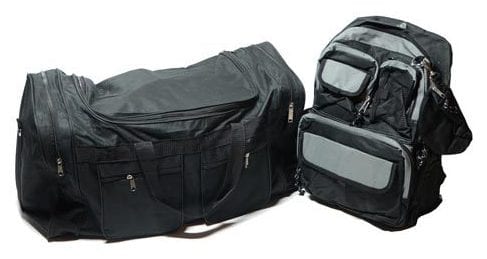
How to Catch Fish for Survival
If you are stuck in the wilderness, fish can be an important source of protein and nutrients in your diet. These tips and techniques to catch fish for survival are intended for emergency situations only. We do not recommend using them in your regular outdoors experience as some methods are illegal in certain areas.

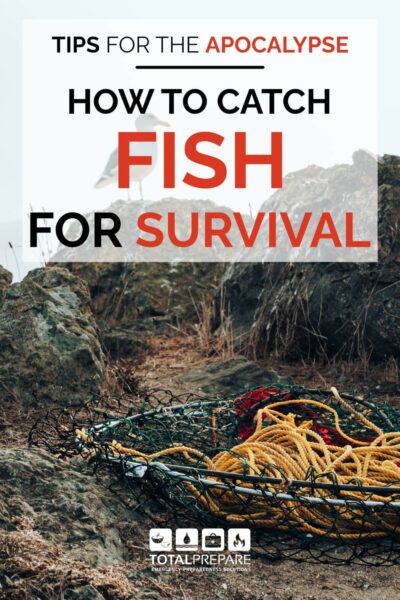
Photo by Meritt Thomas on Unsplash. Text and other elements added by Total Prepare.
When harvesting fish in a survival situation, your goal should be to collect live fish in an area so you have them on hand for meal time. You’ll be most successful if you implement multiple strategies at once. Passive techniques are best as they allow you to work on other things (e.g. building a fire or finding shelter) while the fish do all the hard work.
1) Set multiple lines
Depending on how you wound up in this situation, you might have had the foresight to pack some fishing line and hooks. You might even have something as handy as a folding shovel that comes with a length of line and a few hooks hidden in the handle.
You’ll want to put as many lines in the water as you can to maximize your chances of getting a catch. The lines can be attached directly to overhanging branches, or to makeshift fishing poles made from strong sticks or reeds. Don’t forget to bait the hooks – worms work best and are usually easiest to find!
If you happen to also have some paracord or rope around, you can skip the pole and run a trotline across a body of water. Hang multiple fishing lines from the trotline, making sure they hang at least a few inches into the water.
2) Spear fishing
If you have to do some emergency fishing, you may as well look cool while you do it. Naturally, this means wielding a spear. You can make a spear from any strong length of wood, metal, etc. Sharpen the tip or attach a sharp point. It is best if you can have a barb on your spearhead so the fish don’t just slide off again once you have them speared.
Watch for where your shadow is falling, as it can scare the fish away. Lastly, light refracts when it hits water, making things appear a little higher than they actually are. To counter this, always aim for just below where you see the fish.
3) Funnel traps
Passive funnel traps are a wonderful tool for survival fishing as you can be doing other things while the trap does the work. To build a funnel trap, find a container to use as your holding compartment. Create a funnel into the container with an opening large enough for the type of fish you hope to catch. These are similar in nature to pop-bottle wasp traps – the fish can swim in, but have a hard time finding the exit again.
If you don’t have any good funnel materials, you can often achieve the desired effect by tying/weaving sticks together.
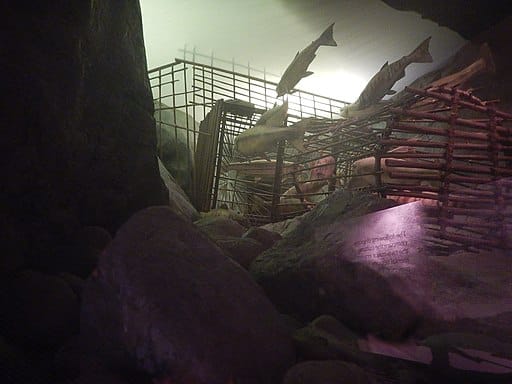
(*Author’s note: if you find yourself in Victoria, BC, our Royal BC Museum has some excellent examples of fish traps and weirs in their First Nations exhibits.)

Photo of the weir exhibit at RBC Museum by Blake Handley from Victoria, Canada, under a CC BY 2.0 licence, via Wikimedia Commons
4) Fish weirs
The last method of survival fishing we’ll cover is a fish weir. A weir is basically just a wall with holes in to let water pass through. Build a weir from piled stones, or by driving stakes side-by-side. The weir should stretch from one bank to the other, with the only gap leading to where you want them to go. This is most likely directly into your funnel trap, or into a blocked off pool for later capture.
Summary
If you liked this article and want to learn more about survival fishing techniques, check out Angler’s original article here. And if you’re building a go-bag or wilderness survival kit, don’t forget to pack those hooks and lines! They take up very little space and make a BIG difference in an extended emergency.
Thank you for reading!
This article was written by Zenia Platten – Author and emergency preparedness professional.
Who Has the Burden of Responsibility In An Emergency?
Who’s responsible in the event of an emergency? At Total Prepare, we hear it all when it comes to who takes on that burden. People say that ‘the government will take care of us’ or ‘my parents have supplies, we’ll just go there’. Today, we’ll dive into the areas of responsibility in an emergency. Discover what help we can expect if the worst happens. Above all, it pays to know just who’s responsible when the world goes awry.

Photo by Reid Naaykens on Unsplash. Text and other elements added by Total Prepare.
Who’s Responsible: Myth-Busting
First things first. Here in Victoria BC, we have a persistent rumour that there is a large cache of supplies. People believe that there’s a massive reverse osmosis water filter tucked away in the capital, ready to take care of the population. I’m sure there are similar stories in every city.
We have provided emergency supplies to individuals and government for over a decade. In all this time, we have yet to see anything to indicate the government will provide food, water and supplies for everyone.
Many government buildings are equipped with short-term supplies for staff – and this should be true for all organizations. A few BC municipalities go above and beyond with supplies for a few hundred residents, and certain organizations are prepared for a week or more of self-sustainability. These include local Emergency Operations Centres and many first responders. However, once again, this is only for staff.
Which makes perfect sense! It would be expensive, cumbersome and nearly impossible to have one organization preparing for every citizen in their jurisdiction.
Who’s Responsible? Here’s What We Do Know
Every disaster we witness – from forest fires to earthquakes to pandemics – makes us more certain that Public Safety Canada is correct in their assessment that:
“All Canadians also have a role in building resilient communities, helping to keep hazards from becoming disasters and in recovering from disasters when they do happen. “Be Prepared”.”
Bob Black, a Central Saanich emergency manager for over 20 years, puts it another way:
“All members of the public have a responsibility to prepare themselves for an emergency or disaster. Understand the hazards and risks in your local area. Register for community-alert processes. Have an evacuation plan. Have an evacuation “grab and go” bag. Be aware of your surroundings. Take ownership of your preparedness.” – Times Colonist, 2018
The experts agree! If you are able to prepare, it is your responsibility to do so. In a major disaster, the government will have its hands full helping those in serious need. Take a step in the right direction. Citizens should do what they can to minimize the government workload during these times.
Who’s Responsible: Your Network
You should feel comfortable going to your family and neighbours when you need help. BUT they should not be your sole supply plan.
Coordinate with them to maximize the neighbourhood’s resources and check up on each other in emergency situations. Be sure to have your own plan and supplies at hand.
However, this may not be an option for you. If that is the case, be sure to talk to the people you will be relying on. They need to know they’ll have an extra mouth to feed. A week’s supply for two people quickly dwindles to less than five days if you unexpectedly throw an extra person into the mix.
Who’s Responsible and What Do You Do?
Follow Bob’s great advice! Purchase or build an emergency kit. Make sure to have a minimum of one week’s self-sufficiency items packed away. As a minimum, food and water are a must. Remember to include the tools to prepare and serve the food. For a full suggestion list, check out our brochure on Sheltering in Place.
Be sure to visit your local municipality website to learn about the hazards in your area and how best to prepare for them.
Double check that they will apply to you. For example, your area might be in a tsunami zone, but you may be on high enough ground that evacuation would be unnecessary.
Last but not least, sign up for your local emergency alerts. These systems are constantly improving in accuracy and coverage. They are one of the best ways to stay in touch with emergency coordination efforts across a city, province or even a country.
Who’s Responsible : Who’s Who in Emergency Response
At this point, some people will be wondering, If I’m doing all that – what are the emergency responders doing? Great question! There are a dizzying number of organizations, roles and resources involved in responding to a major disaster. If SHTF, they each have unique duties and responsibilities to help our communities endure.
First Responders
The local level is where all emergency preparedness begins. Paramedics, firefighters and police/RCMP officers are going to be the first line of defense in a disaster. Their responsibilities will be dealing with the immediate dangers – fire, injury, collapsing structures, rescue and coordinating evacuations.
Being prepared is vital for these brave workers. This preparedness applies to both the workplace and at home. In an enduring emergency, they may be required to stay on site for days or even weeks. A priority for fire services is to ensure that they have the supplies to maintain their crews during these situations. This is especially true in major urban areas.
(Did you know that Total Prepare offers a turnkey solution for firehalls? It provides the calorie counts and protein levels they’ll need in the field. Contact us for more info.)
Home preparedness is equally important for first responders. While on duty, they need to know that their families have everything they’ll need. Fortunately, Total Prepare offers discounted employee buying programs for many first responders. By using these programs, these workers can ensure that their homes are supplied for emergency situations.
Emergency Volunteer Safety Programs
Canada’s provinces and territories are fortunate to have great volunteer programs in place. Citizens can sign up and receive training which enables them to help in all kinds of emergencies. These organizations will provide much needed manpower in the event of an emergency. In BC, our emergency volunteer programs include:
Search and Rescue
There are approximately 2,500 registered Search and Rescue volunteers in BC.
These volunteers usually search for someone who has gone missing. Searches can be carried out in the wilderness or in and around collapsed buildings, and there are different types of SAR teams. One such example is those specializing in cave or rapid water rescues. You can learn more about what groups are in BC on the BC Search and Rescue Association Website.
The police/RCMP may call on SAR volunteers to search for lost individuals in an emergency. In some cases, specialized tools and training may be necessary. SAR volunteers may then be tasked to locate and transport injured persons. They also help to distribute information during evacuations and other critical response activities.
Emergency Communications / PERCS
PERCS stands for the Provincial Emergency Radio Communications Service. Individuals volunteering with this organization are amateur radio operators. They work together with Emergency Management BC to aid in communications during an emergency. They will be a critical resource if there is damage to standard methods of communication.
Emergency Support Services
ESS is a provincial program. Local authorities and/or First Nations governments are usually responsible for their delivery.
Their goal is to “meet the basic needs of citizens impacted by disasters by providing short-term support in a compassionate manner.” ESS support is designed to get individuals in need through the first 72 hours of an emergency.
ESS is the responsibility of municipalities and regional districts under the Emergency Program Act. However, they often depend on volunteers for much needed people-power. These volunteers train to:
- Coordinate the provision of food, clothing, lodging, emotional support, pet care and transportation.
- Identifying locations for reception centres
- Working together with local government, businesses, etc.
- Providing information about the crisis
- Coordinating other volunteers
- Family reunification
Most ESS teams work in their local municipalities. When the need arises, there are also mobile teams that travel to other communities on short notice.
Emergency Recovery Resources
After the initial disaster, there are resources in place to help the community regain a sense of normalcy.
- Red Cross Support Centers: Similar to ESS, Red Cross can provide basic supplies for up to 72 hours after an emergency.
- Insurance Bureau of Canada: The IBC works with individuals and businesses to address questions and concerns regarding their insurance.
- Mental Health Resources: Places where professional help and emotional support can be found when we need it most. Organizations include BC Crisis Centres, Aboriginal Crisis Line, Kids Help Phone and BC211.
- Business and Agriculture recovery programs including the Agri-business planning programs and community futures.
Emergency Management BC
EMBC is the ‘big wig’ of emergency preparedness in our province. EMBC employees ensure that all emergency response in BC is done in a coordinated and organized fashion. Some of EMBC’s day-to-day responsibilities include:
- Establishing standard terminology
- Guiding principles and processes for all stakeholders in the emergency response chain of command

Local governments may become overwhelmed in the event of an emergency. EMBC provincial regional emergency operations centres (PREOCs) then provide support. And this is especially true in large scale emergencies. Emergency management staff make up the PREOCs. They are trained to help with coordination, planning and logistics. There are six PREOCs in BC.
Multiple PREOCs may be activated at once. In that event, EMBC can open up its PECC. PECC stands for Provincial Emergency Coordination Centre. Located in Victoria, the PECC acts as a headquarters and supports and coordinates with the PREOCs.
EMBC staff also do a lot of work educating and encouraging people to be prepared. Their outreach extends to citizens, businesses and all other organizations. They also lend support to the volunteer services we discussed above. Other areas EMBC is responsible for include: response, planning, training, testing and exercising. It’s a big job!
Summary
Emergency preparedness starts at the personal level and works out from there.
Remember it is every individual’s responsibility to do what they can to prepare for an emergency. This alleviates the pressure on our volunteers, first responders and government organizations. Being prepared is the responsibility of all individuals. Individuals must take ownership for their own safety and well-being because, by doing so, it then ensures that resources can be delivered to where they’re needed most.
The best course of action is to learn your local hazards, get a kit and sign up for emergency alerts. Once you get all of that done, stay tuned for our next post on how to make a family and reunification plan.
Thank you for reading!
This article was written by Zenia Platten – Author of Tethered and Emergency Preparedness Professional.
How To Find Shelter in the Wilderness

Photo by Harlow Kasprak – Websitethink.com on Unsplash. Text and other elements added by Total Prepare.
Extreme conditions can quickly move “find shelter” to the top of your priority list, even above food and water. In many parts of Canada, freezing to death is a very real concern for those lost outside—even in the summer. I fondly remember a camping trip to Banff, AB where we woke up to the sound of snow collapsing our tarp… in June. It was a very rude awakening to us soft Victoria kids, and it made me wonder: How would we have fared without the tent? Read on to learn how to find shelter if you get yourself into a similar situation.
Where to Look
Your ideal shelter site should have:
- Materials nearby for building
- A water source nearby
- Wind breaks (trees or rocks usually)
- No danger of flooding
- No danger of landslides
Finding Natural Shelters
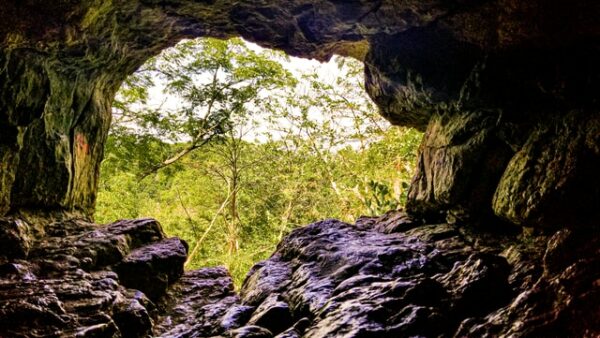
The outdoors is full of natural shelters that can be used in an emergency. Keep an eye out for caves, hollows, or even hollow, dead logs that might fit your body. Be aware when scouting out these locations—they may already be occupied. Look for scat on the ground nearby, if it is warm go elsewhere. If you find a good spot, try to light a fire at or near the entrance to ward off any wild visitors.
Keep shelters small. The smaller the space, the easier it is to heat. Take care to watch for holes, steep drops, and other hazards while searching, especially in hollows and caves.

Natural caves can provide most of the protection you need. Photo by Jacob Kopplin on Unsplash.
How to Use Tree Wells
Tree wells may be one of the easiest locations in which to find shelter. Look for large trees with roots that create a sheltered depression. Enlarge the tree well and use tree limbs or—if available—a tarp or spare emergency blanket for a roof. If you are doing this in snowy conditions, be aware that tree wells in snow can be very deep and it can be easy to fall into them. In these instances, you’ll want to use a snow cave instead.
How to Build a Snow Cave
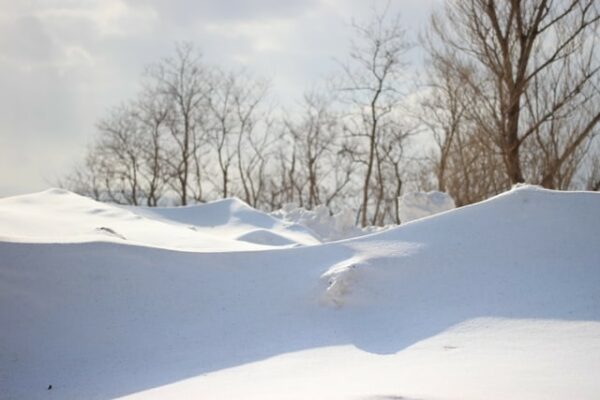
Most regions in Canada offer opportunity to even find shelter in snow- not so much on Vancouver Island however. Find a snowbank at least five feet high and dig a tunnel into it. At the end of the tunnel, create a chamber that you can fit comfortably inside, and poke a few holes in the roof for ventilation. If conditions are not right for a cave, or if you’re worried about collapse, dig a trench in the snow instead and create a roof from tree limbs, a tarp, or a spare emergency blanket.
How to Construct a Lean-to
Lean-tos are a staple of survivalists everywhere. They are simple to build and a popular choice for those in need of a quick emergency shelter. Use logs or rope to build a frame and fill in the walls with sticks, branches, bark or whatever else is to hand that will do the job. The easiest shape to build is a triangle, so don’t try to get too fancy with DIY log cabins or tipi-style shelters. (Unless you have experience and can do it well, of course.)
Find Shelter in the Wilderness
Once you have found shelter, ideally, you want your shelter to be small, low profile, and hard for curious animals to spot. However, this will also make it difficult for rescuers to see you. Therefore, light a fire if you are able, or leave a written message for searchers nearby with arrows to your hiding place.
Happy trails, and thank you for reading!
This article was written by Zenia Platten – Author and emergency preparedness professional
How to Find Your Way in the Wilderness
It’s easy to lose your way in the Canadian wild. Do you know how to find your way in the wilderness? Whether you’ve taken a wrong turn on an adventurous hike or wandered too far from your campsite looking for firewood, here are some survival tips to get you back to where you need to be.

Photo by Michael Krahn on Unsplash. Text and other elements added by Total Prepare. Click here to pin this article.
How to Prepare Ahead
If there’s a chance you may lose track of your campsite, trail, or your companions, make sure to bring a compass and map with you. However, for the purpose of this article, we’ll assume you are in the wilderness only the clothes on your back.
You’re Lost: Now What?
If you believe you are lost, stop. Don’t panic. Take deep breaths, and don’t go anywhere until you can think clearly. If you run—even for a little bit—you will only disorient yourself further.
How to Mark Your Trail
Create trail markers as you move. You could go Hollywood and use torn scraps of clothing, but scoring trees with a rock (or a knife, if available) is generally a better idea. You’ll really appreciate the extra sweater if you need to camp out overnight.
Leave markings frequently and indicate which direction you are heading. This will help rescuers to find you and make it easier to retrace your steps.
Find Your Way: What’s The Safest Way to Retrace Your Steps?
Once you have marked your starting place (make this one distinct from the other markings), try to retrace your steps. If you know you were only off the trail for 10 minutes, don’t walk for more than 15 minutes in any one direction. If you don’t find the trail in that time, follow your markers back to your starting place and try again in another direction. Keep this up until you find the trail.
What Should You Do Next?
You’ve retraced your steps in every direction with no luck. Now it’s time to strike out on your own, following moss trails and communing with the land to find your way in the wilderness to get home, right? Wrong.
Your mission—should you choose to accept it—is to stay as close to where you originally were as possible. If you have the tools available, build and light a fire—carefully—for warmth and light, then hunker down. In most cases, you are probably not far from where you should be, and someone will find you quickly.
How to Assist Search and Rescue
If you were travelling with a group or if you’ve been missing for a long time, you likely have people looking for you. Use markers to make yourself easy to find. Be sure to make noise. Call for help, whistle, and create markers that can be seen from the air. Unless you need to take shelter from the elements, stay out where search teams can see you. You don’t want them to miss you if they come through the area.

Move downhill until you find water, then follow it until you find civilization. Photo by Holly Riley on Unsplash.
Tips and Last Resorts
If you really must strike out on your own, or if no one is likely to report you missing, here are a few things to keep in mind when navigating in the woods:
- The sun rises in the east and sets in the west. If you know where civilization is relative to your hiking spot of choice, use the sun to head in that direction.
- Walk downhill until you find water and walk downstream. The going might be tough at times, but you’re more likely to find a community along a waterway or in a valley.
- Take advantage of any viewpoints and scan for signs of people/civilization. This could be as small as a gap in the treeline that might indicate a road.
Summary
If all goes well, hopefully you will never get lost and need to remember how to find your way in the wilderness. Tell someone if you’re leaving for a hike, where you are going, and when you expect to be back. At minimum, bring water or a way to filter water, as well as a compass, map, and knife if you’re able.
Thank you for reading, and happy hiking!
This article was written by Zenia Platten – Author and Emergency Preparedness Professional
How to Build A Fire
Learn how to build a fire with Total Prepare’s quick how-to guide so you can stay warm and dry when you need it most.
Despite how easy it is to start an accidental fire in your house or the forest, it is infuriatingly difficult to light one on purpose if you don’t know how. There is a lot more to it than simply throwing a lit match into a pile of timber and hoping it catches.

Photo by Benjamin DeYoung on Unsplash. Text and elements added by Total Prepare. Click here to pin this article.
Why do I need a fire?
Whether you are forced to shelter in your backyard in winter or you get lost out in the wilderness or stranded on a lonely highway, fire can save your life. It creates warmth, light, and is a good way to cook food. It can stave off hypothermia and predators while attracting rescuers. When handled safely, fire is an excellent—even fundamental—survival tool.
What are the first steps in building a fire?
The first two points to consider are location and materials. Look for a place that is dry, out of the wind, and has nothing overhanging it, such as trees or buildings. The last thing you want is for a stray spark to create a whole new emergency to deal with.
You will need different types of wood to burn:
- Logs will provide the bulk of your fire. Aim for pieces that are around a foot long with a diameter a little wider than your hand. Logs that are too large are more likely to burn out of control and can be difficult to gather. Pieces that are too small will burn quickly and require careful watching to avoid the fire burning out.
- Large kindling, like one- or two-inch-thick sticks, will help the fire grow and catch onto your logs.
- Fine kindling, fire starter, or newspaper will provide the fuel you need to get the flames going. They burn quick and hot, hopefully catching to your larger pieces and giving the fire a foothold. Many fire starters can be improvised: hand sanitizer, cotton tampons, and pinecones can all be used to get a fire started.
Make sure all burnables are as dry as possible—you won’t have much luck getting wet wood to light. Naturally, you will also need a way to create the initial flame or spark. A lighter is the easiest method (be sure to keep one in each of your emergency kits!), but matches, flint and steel, or certain multi-tools are great options too. If you are new to fire-starting, aim for sources that give you a flame to work with, rather than a spark.
How to get your fire started
Clear a wide area around where you plan to have your fire. Anything that you might pick up as kindling—stray branches, pine needles, etc.—can also be ways for your fire to accidentally spread out of your control. Create a ring of rocks to use as a makeshift fire pit and to clearly mark your intended boundary for the fire—around 2 ½ feet diameter is ideal. This will also help to contain it. If it is windy, building your wall higher can create a shelter for your flames. If possible, have water on hand to put out the fire if it starts to get unruly.

Photo by Alison Dueck on Unsplash
Once you have your fire pit in place, here’s how to build a fire you’ll be proud of:
- Place your fine kindling, fire starter, or crumpled newspaper into the center of your circle.
- Create a square around your fire starter with your larger kindling, layering each piece to leave airflow.
- Use a few pieces of smaller kindling to create a teepee-shaped triangle over your newspaper, but within your square pieces.
- Light your newspaper.
- If needed, gently blow on your fire to feed it oxygen and help it grow.
- Once your fire gets burning, layer a few more pieces of large kindling on top, slowly using bigger pieces as your fire gets stronger.
Be careful not to smother your fire. It needs air to burn, and piling too much fuel on top can starve it of air and cause it to smoulder out. Monitor your fire carefully and add more wood as required to keep it burning at your desired size.
Summary
Fire is one of the key tools that put humanity on the map. With a few tricks and tools, you can learn how to build a fire for an emergency with this simple guide. Keep warm, stay safe, and be sure to practice when camping! (Mmm… marshmallows…)
And while you’re here, check out some of our fire starting tools to get you (and your fire) started!
This article was written by Zenia Platten – Author and emergency preparedness professional.
What We Can Learn From Christchurch
This year marks ten years since New Zealand’s fifth-deadliest disaster in Christchurch, a city on the country’s South Island. In early 2011, a series of earthquakes shook the region, costing over 100 lives and billions of dollars in damages. Ten years later, recovery efforts are still in progress. There have been many high-magnitude earthquakes around the world since then, so what significance could the Christchurch earthquake — which occurred half a world away from our home here in Victoria, BC — hold for us Canadian west coasters? It turns out, quite a lot.
Approximately half a million measurable earthquakes happen every year – that translates to one every 3-4 minutes. Happily, only an average of 8 of these are magnitude 7 or higher – which means they’re more likely to cause damage or loss of life. The most major quakes to occur in a single year were the 24 magnitude 7+ events that occurred within 2010.
One of these hit Christchurch — a m7.1 on September 4, 2010.

Photo by Francis Vallance on Flickr.
Shaken Up
“The” 2011 Christchurch earthquake is a misnomer. There were actually several quakes — the strongest being that one in early September of 2010. Each of these caused damage, but more critically, they weakened the local infrastructure. The last straw came on February 22, 2011 when a m6.3 aftershock struck.
While not as strong as the initial event, the aftershock occurred beneath the Christchurch suburb of Heathcote Valley. Occurring only 3 miles (5km) underground, it was shallow by seismic standards. The area saw substantial shaking, surface cracking, and liquification (when previously solid ground becomes fluidlike).
The Damage
There are hundreds of stories and perspectives from the survivors of the February 22, 2011 event. The shaking destroyed homes and businesses, resulting in 185 deaths. By 2013, estimates put the cost of rebuilding after the disaster at $40 billion dollars. There is no word on how close that estimate has been so far.
Both the damage and the multi-year battles with insurance companies meant that homeowners struggled to afford repairs. After the disaster, 2.4% of Christchurch’s population (8,900 people) moved elsewhere in New Zealand. Some left the country altogether.

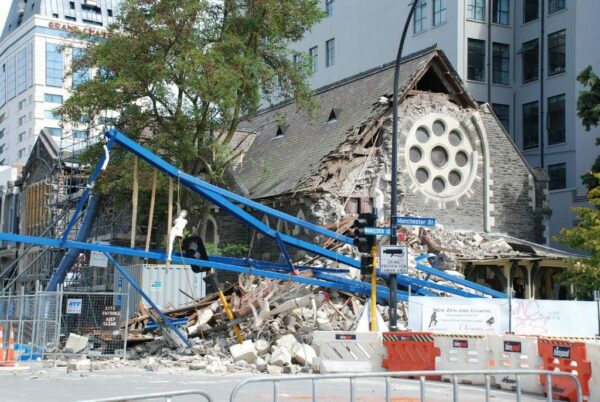
The Trinity Building in Christchurch after the 2011 earthquakes. Photo by Geof Wilson on Flickr, licensed under the Creative Commons Attribution-Share Alike 2.0 Generic license.
To this day, the city has declared a ‘red zone’ of 630 hectares of land too unsafe to build new homes on. This land was cleared of the thousands of destroyed homes and now stands in limbo. While some residents refused the government’s offer to buy out their homes and chose to continue living in the red zone, their crooked houses serve as a sobering reminder of the risks.
Residences were not the only affected structures. Businesses, landmarks, roads, water mains, sewage pipes, and electricity and phone lines all met the same fate. The city’s central business district remained closed for two years after the quake, nestled among the “living ruins” of the city.
Casualties
As with any disaster, the most tragic and irreplaceable toll were the lives lost. Falling buildings crushed or buried cars, buses, and pedestrians. Most of the casualties – 115 out of the 185 deaths – occurred after the six-story Canterbury Television building collapsed, leaving only its flaming elevator shaft standing. The building housed a TV station, a medical clinic, and an English language school. Twelve Japanese students were among the fatalities.
The earthquake left 80% of Christchurch without electricity. Water and sewage disruptions spanned across the city. Within three days, 75% of residence had power restored; however, water and sewage systems took several years to restore in certain areas. The remaining 25% of homes without power were addressed over the next 2-3 weeks.
Damaged water mains and liquefaction caused flooding in several suburbs. While no one drowned due to the flooding, there were some close calls. Vehicles driving or falling into sink holes filled with water or liquified earth, and people became trapped in silt-filled holes. After the waters receded, communities gathered to dig out the properties of residents from the thick silt left behind.
Post-Earthquake Recovery
After the earthquake, the New Zealand Prime Minister and the Mayor of Christchurch announced the creation of the Canterbury Earthquake Recovery Authority (CERA). This organization would manage post-quake recovery in the area, working in tandem with government and local councils.
The Christchurch earthquake damaged over 100,000 homes, with around 10,0000 requiring demolition. Agricultural parks and racecourses served as sites for temporary housing. Under their insurance policies, some residents were offered properties in new subdivisions. Many chose to live in their homes while emergency repairs were completed – some waiting for years for their insurance to resolve.
Most schools in the area remained closed for weeks after the event. While many were cleared to return to their original sites, some classes were held either in tents on school grounds or shared space with other, less damaged schools. Many families relocated after the disaster, lowering enrollment numbers and causing some schools to merge permanently.
Where Are They Now?
By 2016 – five years after the earthquakes – 90% of private insurance claims were settled. Some residents of destroyed homes lacked other places to live and made do with severely damaged properties for years as they waited for settlements.
The ‘Red Zone’ land that has been marked as unsafe for future construction is currently maintained by Land Information New Zealand, which manages vegetation, provides security, and clears trash. The space is used for mountain biking, community gardening, and occasionally for festivals. Some of the damaged roads are used for road safety training for kids or for testing autonomous vehicles.

Christchurch reconstruction efforts. Photo by rheins on Panoramio. Licensed under the Creative Commons Attribution 3.0 Unported license.
What Does This Mean For BC?
The events in Christchurch in 2011 were tragic, but distant. So why should Christchurch’s seismic events be especially meaningful for us? Christchurch and Victoria, BC have a lot in common. Even a decade later, we can learn important lessons from the stories, experiences, and recovery efforts in the aftermath.
Similarities
In 2011-2012, Christchurch had a comparable population to the Victoria area – 380,000 compared to 360,000 people living in the CRD. We also share/shared similar heritage-style downtown cores, featuring older buildings and lots of brickwork. Both Christchurch and Victoria are also located in seismically significant areas. The likelihood of BC’s west coast experiencing a similar (or greater) magnitude earthquake in the next 50 years is 1 in 3. Both cities are also at risk for tsunamis after seismic events.
Where Victoria Differs
We are lucky here in BC to have a few advantages in the event of an earthquake that Christchurch did not, but we also have our own challenges.
Apathy. Despite BC and New Zealand having similar populations, a much smaller percentage of people in BC have earthquake insurance (about 50%). In general, west coast BC seems to have a higher level of apathy when it comes to earthquake preparedness in general, including insurance, emergency kits, and personal emergency planning. In a recent provincial survey, only 13% of BC residents said they had a complete emergency plan, and only 39% had at least 3 days of supplies gathered in one place. When asked why they are not fully prepared, the most common answer is ‘laziness.’
Neighbouring cities. Unlike Christchurch, Victoria has some big neighbouring cities that are also likely to need help in the event of a large earthquake. Vancouver and Seattle will likely take precedence for aid due to their size, meaning that Vancouver Island may have longer to wait for outside help than Christchurch did.
However, the proximity of our neighbours may also prove to be a boon. If they suffer minimal damage from a natural disaster, they’ll be well-placed to provide aid to Victoria and the island.
What do we do?
Wondering what can be done in the face of natural disaster? The first step is to take a deep breath and decide to be prepared, not scared. From there, it is as easy as following the steps laid out by PreparedBC: know the risks, make a plan, get a kit.
Know The Risks
Understanding the risks in your area will help you know what exactly you are preparing for. In the CRD, the top emergencies to prepare for are earthquake, fire, and severe weather. But beyond that, one should educate themselves on what dangers are caused by these disasters. Earthquakes, for example, are famous for the damage caused by shaking – fallen buildings, cracks in the roads, etc – but they are more complicated than that. Liquefaction; damaged water, sewage, and gas lines; fires and explosions caused by crushed or damaged fuel tanks; tsunamis; and downed power lines are all earthquake hazards that can be often overlooked.
Make A Plan
After studying the hazards in your area and researching what extra effects they may have, it is time to make a plan. Ensure everyone in your household knows the plan and practice it once a year. Think through how you and your loved ones would reunite if an earthquake happened while family members were in different places (school, work, the grocery store) and how you could support furry friends and loved ones/neighbours with special needs.

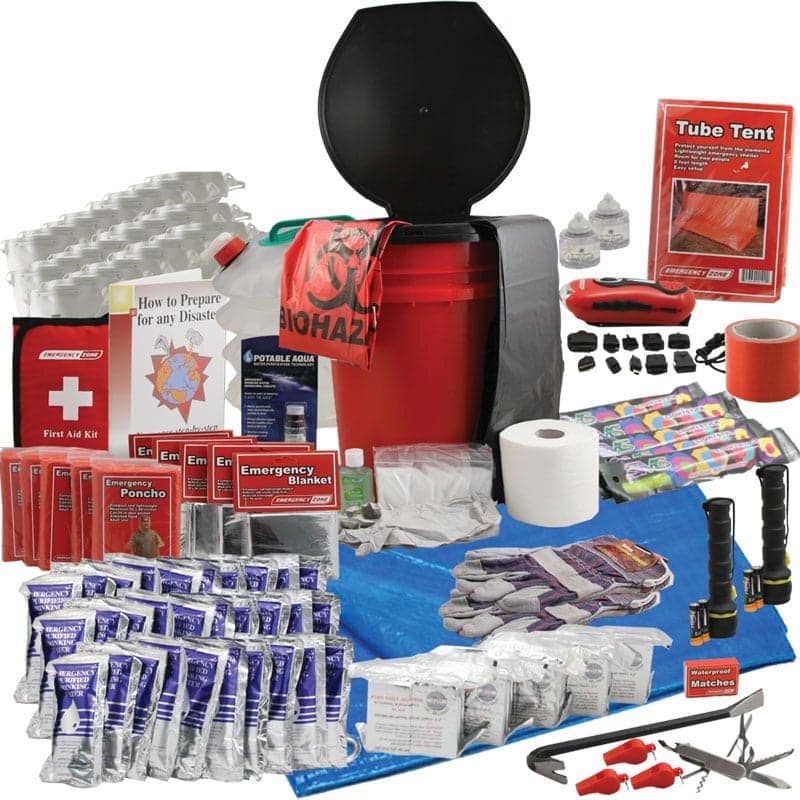
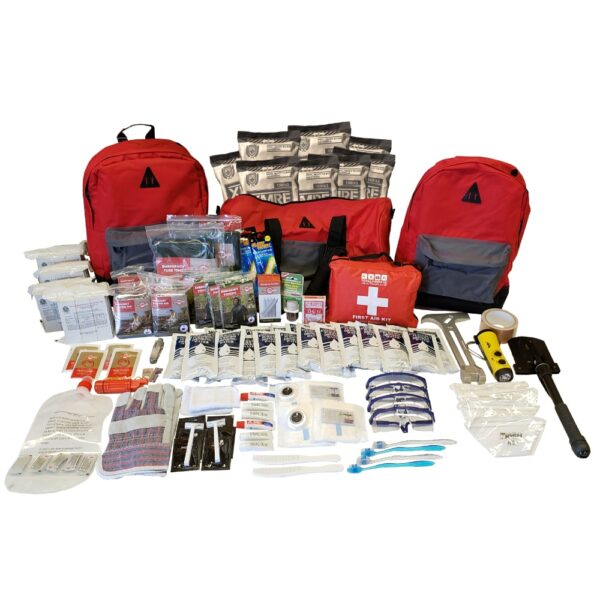
A 4-person emergency kit. Photo by Total Prepare.
Get A Kit
Once you know what you are preparing for, and what you plan to do about it, the next step is to create or purchase an emergency kit. Having supplies on hand gives you flexibility. If your house is suddenly compromised or you need to evacuate, you have everything you need for a few nights outside or in a reception center, on hand and ready to go. Pack a minimum of 3 days’ food and water (at least 3600 calories of food and 6 liters of water per person), shelter supplies, flashlights, a radio, and spare copies of important documents. Looking for our favourite 72-hour kit option? Check out the Total Prepare staff-built Premium 72 Hour Earthquake kit. While a 72-hour kit is a great place to start, professionals recommend having 1-2 weeks self-sustainability for earthquake scenarios.
Summary
A lot has changed in the last year, let alone the last decade, but plenty has stayed the same too. BC’s emergency planning officials are working tirelessly to raise awareness, create strategies, and ready everyone in our province for disasters of every sort. Between early warning systems, growing Search and Rescue teams, and public educational opportunities, they are doing an amazing job. But preparing millions of people for a life-changing risk is no small feat, and the risks we face today have changed very little from what they were 10 years ago.
By studying seismic events from areas similar to our own, we can better understand the risks posed by living on a fault line. With understanding, we are able to create a plan. Once we know our plan, we can build the best emergency kit possible for our unique situations.
Thank you for reading. Know anyone with experience in a major earthquake? Let us know their stories and advice in the comments!
This article was written by Zenia Platten – Author and emergency preparedness professional.
Can Humans Cause Earthquakes?
Can humans cause earthquakes? Humanity is pretty powerful but does our power reach this far? Natural earthquakes are caused by the earth’s tectonic plates rubbing together or pressing into one another. Can we rival forces on such a massive scale?
Can humans cause earthquakes? As it turns out, yes we can.

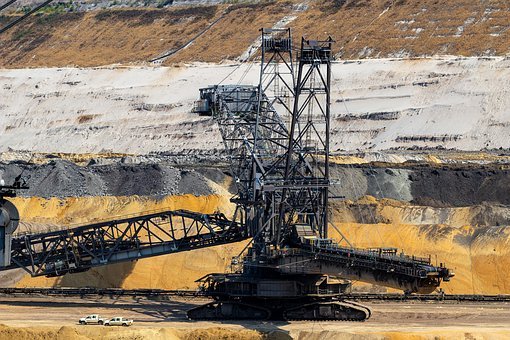
Credit: geralt on Pixabay
The majority of earthquakes are natural. However, scientists have been aware of our ability to influence seismic activity for many years. A study published in the journal Seismological Research Letters identified 730 sites where earthquakes have been caused by human activity in the last 150 years. What scientists weren’t expecting was that not all of these man-made quakes were small. Humans have induced earthquakes as large as 7.9M! That’s a big quake!
What are humans doing to cause earthquakes?
If you were picturing Dr. Evil standing beside the QuakeMaster6000 and rubbing his hands together, then I’m sorry to disappoint you. What exactly are humans doing to cause earthquakes? In a nutshell, man-made quakes are most commonly caused by mining, reservoir impoundment, or dam building.
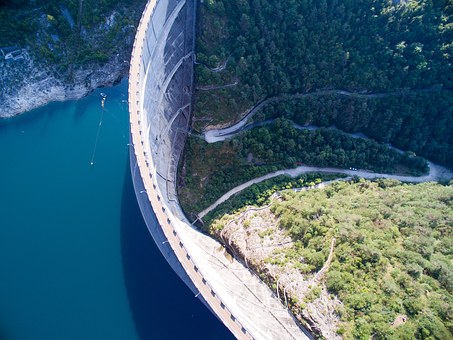
Many man-made quakes happen far from fault lines. However, the largest was directly over a known fault line in China. Scientists believe that the Zipingpu Reservoir, and the 320 million tons of water it had collected, triggered the 7.9M quake. This quake alone killed approximately 80,000 people in 2008.
Mining operations remove large amounts of material from the earth which can cause instability. Human-influenced seismic events are caused by these situations. Reservoirs and dams, like the one in China, are less frequent but much more dangerous.
Natural gas and oil fracking are other sources of seismic activity. The act of fracking itself is not all that’s shaking things up though. The high-pressure wastewater created in the process can also contribute by cracking rocks and lubricating fault lines.
Moving forward
Our mining, fracking, and general construction projects will continue to build in size and scope. Therefore, we’ll most likely see more and more man-made earthquakes occur. Some companies are working to study and understand how their work is affecting the world around us and engineering ways to minimize their impact. The goal is to avoid any more quakes as devastating and unexpected as China’s 2008 incident.
In 2017, Oklahoma put new regulations surrounding wastewater disposal from fracking operations in place. In 2016, the region was subject to three 5M+ earthquakes that caused substantial damage. The earthquakes are believed to have been induced by local fracking operations. Since limiting wastewater injection, the number of larger earthquakes has fallen.
Studies show that induced tremors have the same destructive potential as their natural counterparts. Therefore, it is critical that more companies and governments look for ways to mitigate the risks in their area.
What’s happening in Canada?

Canada has several fault lines of note – including our notorious Cascadia and Juan de Fuca fault lines. Although these fault lines have been starred in Hollywood movies and generally get a lot of attention for the overdue ‘Big One’, they have seen little man-made seismic activity in their Canadian region. The Cascadia subduction zone reaches all the way to California where many more induced earthquakes can be seen.
Check out an area for yourself. The University of Waterloo has developed a map showing which regions and population centers of Western Canada are likely to experience earthquakes induced by underground energy extraction. It shows where human-influenced earthquakes have occurred and what was believed to have caused them. It’s easy to see patterns where different industries have stronger footholds.
Summary
In conclusion, while humans can impact earthquakes, the protocols for staying safe are the same in any seismic event. Drop, cover, and hold on. Secure unstable pieces of furniture and heavy paintings and, if you’re able, get your home inspected or renovated for seismic upgrading. Don’t forget to keep an emergency kit handy!
Thank you for reading.
This article was written by Zenia Platten – Author and emergency preparedness professional.
How to Make a Family Emergency Plan
PreparedBC’s steps to being prepared are: 1) Know your hazards, 2) Make a Plan, and 3) Get a Kit.
Today, we’ll be focusing on how to make an emergency plan for you and/or your family. These plans are known as reunification plans, or simply emergency response plans.

Photo by Joseph Gonzalez on Unsplash; text elements added by Total Prepare. Click here to pin this article.
Step 1: Analysis
In orde
r to be prepared, you need to have an idea of what you are preparing for. Think about your local area and look into what hazards are likely to affect you. For how long should you be prepared to be self-sufficient if these emergencies come? Will they affect only a small area, perhaps just a single building, or will they be on a larger scale? A house fire requires a very different response than an earthquake or hurricane.
In this step, take some time to really think about where you and your household spend their time and how they are likely to be affected if an emergency happens. With this firmly in mind, it is time to make a Family Emergency Plan.
Step 2: Immediate Response
Once you know what you may face in an emergency, it’s critical to know how to respond to it as it is happening. I recommend putting these processes right into your emergency plan and referring back to them at least once a year to practice the procedures.
For a house fire, this might mean practicing crawling under smoke, going to your meeting place, or using unusual exit points for your home. One of my strongest memories as a kid was getting to climb out of my bedroom window and off the roof as part of a fire drill. Going through the motions and imagining why I might need to be doing these things hit home much more clearly than any lecture could have.
Step 3: Reunification
Emergencies can happen anytime. They usually don’t wait for everyone to be home and safe before striking. This is why creating a plan to reunify your household in an emergency is so important.
If little Jimmy is at school, Mrs Jimmy is at work, Mr Jimmy is at his parents’ house and Jimmette is at college, how does everyone find one another? Who is responsible for picking up little Jimmy? Does Mr Jimmy stay with his parents or come home?
This is the most important step in making a Family Emergency Plan.
Consider where each member of your household spends their time. Establish guidelines and contingencies for how each person gets to your meeting place, and where they will go if your meeting place is not safe. Plan at least two routes in and out of locations in case some roads or exits are impassable.
Once everyone is together, where will you go if your home is not viable? Do you have an emergency kit you can take with you? And, of course, who do you call to let loved ones know you’re alright?
Step 4: Establish an Out of Town Contact
If your family is living apart – Jimmette might live on campus for example – you need to establish an out of town contact. This should be someone who is unlikely to be affected by the same emergency as you, often in a different province, and who answers their phone reliably.
Everyone in your household should know this person’s contact information or have it in their phone/wallet. Make it part of your plan that each person checks in with the out of town contact. Let them know that they are safe and get news of other family members. This will allow the contact to coordinate communications from a safe place. If the phone lines are not working, texts will often still go through.
Be sure to ask your contact for permission before making them responsible for your family communications. Ensure they understand their role and are okay with taking it on.
Step 5: Consider Everyone
Once plans are in place for all the members of the Jim family, we need to look at their immediate circle. Pets, parents, neighbours, or others that may need help from the Jims, should be considered in the plan. This could be as little as checking in to make sure that everyone is okay, or as much as adding extra supplies to your kit to ensure their pets don’t go hungry.
Step 6: Share and Teach
Once you have your plan ready to go, sit down with those involved in your plan and discuss it.
Take feedback and confirm that everyone has a good understanding of what to do in an emergency. Schedule drills and kit-checkups at least once a year to keep everything up to date and top of mind. If something changes, update the plan. Don’t assume everyone will automatically pick up on the change.
Summary
The government of Canada has a great resource to help you make your plan which you can find here. Be methodical in your process and be sure to document what you come up with. If you begin to feel overwhelmed, take a break, but be sure to come back to it. A plan is one of the most important parts of being prepared, whether you are living on your own, or have an extensive, multi-generational household.
Thank you for reading. This article was written by Zenia Platten – Author of Tethered and emergency preparedness professional.
Preparing for Emergencies as a Couple
We all need to get prepared in case of an emergency in our area. However, most guides, articles, and products are geared towards families. In honour of our Valentine’s Day sale (today until February 19, 2021), we’re going to shift the conversation towards preparing for emergencies as a couple. In the case of young professionals and students, this usually means a smaller budget and wayyyy less storage space. For older couples, it might be a matter of finding options that don’t go over the top for two people.
Location, location, location
We’ve written posts about where to store your emergency kit (here), but this can be extra tricky if you don’t own property or if you live in a small place. Preparing for emergencies as a couple may require some imaginative planning. My partner and I share an 850 square foot basement suite with a dog, two birds and a few too many hobbies. It can be a struggle to find space for anything – hiding gifts, new books, and yes, emergency supplies.
Useful suggestions
Because I work in emergency preparedness, our kit was a priority for us (okay, for me) so we dedicated as much space as we could to a large tote of general supplies and a few buckets of freeze dried food. This obviously isn’t practical for everyone. Nevertheless, there are options for those looking to get prepared without much wiggle room.
Use your network! Do you know someone nearby with some extra space or an existing kit? Ask if you can add supplies to their stash and coordinate an emergency plan. Try to stick with contacts that are within walking distance in case roads are dangerous. Then all you and your partner will need is a go-bag with enough supplies for 24-72 hours in case it’s not feasible to go right away. Two person kits are part of our ‘Get Prepared Together’ sale until February 17.
Did you know?
Most people already have an emergency kit in their homes without realizing it. If you have camping gear, just add food, water and personal items and you have a kit. That way you don’t take up extra space by doubling up on items like tents, stoves or sleeping bags. If using this space-saver, be sure to keep all of your gear in one place so it’s easy to get to and move if needed.
If you are new to the neighborhood and don’t like the outdoors, the main option left to you is to keep your kit compact. There are some good options like the Individual Essentials Kit, or the Legion Kit, that are built with this need in mind. But be aware that no micro-kit is going to have the same scope as their larger cousins. Supplement these options by stocking extra of your everyday pantry items and rotating through them.
What to keep in your kit
We’ve discussed emergency kits at length in the past. For the most part, when preparing for emergencies as a couple, a survival kit should contain all the same things as a family or individual kit. You’re still human, so you’ll need to cover the basics:
Sustenance:
Water – 2 Liters per person each day for drinking and 2 for cooking and sanitation. Here’s more information on the best ways to prepare water.
Food – Ideally aim for 1600 – 2200 calories per person each day, including decent nutrition and protein. During our Get Prepared Together sale we’re offering discounts on a week’s worth of food for two people here. It even has a 25 year shelf life! New to freeze dried food? Check out our 4 part blog series on it to learn why it is the best option for most kits.
Comfort Necessities:
Warmth and Shelter – Hopefully you’ll be able to stay in your home in the event of an emergency. However, to be on the safe side, it is prudent to pack a shelter. If you don’t camp, your best option is likely a Tube Tent. Another option is to pick up a cheap multipurpose tent from a local supplier.
Sanitation – In some emergencies (especially earthquakes) water might not be coming through the pipes and toilets may not flush. You might also be sheltering in place outside. In these cases you’ll want to have garbage bags as a minimum to help you contain and dispose of waste. If you have the room, a full emergency toilet kit is also an option.
Other:
First Aid – Every home should have a first aid kit, even if they don’t have a general emergency kit. Here are all our options. For space-saving couples, I would highly recommend the Essential First Aid Kit. It’s very handy and compact without missing supplies.
Personal Items – If you have the space, always try to include some personal items in your kit. At a minimum this would be a change of clothes, some cash and toothbrush/toothpaste. It might also include a USB stick with copies of important documents or family photos, a change of shoes, spare glasses/medicine and anything else that would be difficult to live without.
Couple-specific tip – In 99% of cases a kit for a couple will line up with the recommendations for the general population because you are both still people, and people need certain things. This being said, I do have one couple-specific tip for you:
In most emergencies you will be stuck, possibly for days, without electricity. This means a lot of time being bored, together and surrounded by candles or other mood lighting. Pack accordingly.
Summary
If you’re preparing for your future together, take the time to ensure it is a safe one. Pack a kit, talk to your neighbours and use the above tips and tricks to save space and money. Were you able to keep supplies compact and under budget? Tell us about your kit in the comments!
Thank you for reading.
This article was written by Zenia Platten – author and emergency preparedness professional.
What You Need to Know About Emergency Survival Kits
Survival kits come in different shapes and sizes. For the purposes of this article we will be talking about 72 hour to 1 week kits and how they can help you in an earthquake situation.
What Does a First World Emergency Look Like?
No, I’m not talking about losing your Wi-Fi or leaving your cell phone at home. I mean a fire, earthquake, or flood in a first world community. It’s important to look at how these kinds of emergencies would effect a first world city because when we are shown severe natural disasters, the pictures often come from places with less resources to deal with major damage. Our perceptions of what ‘disaster’ means is warped by the drama of those situations. Our culture craves drama, and the media happily obliges.
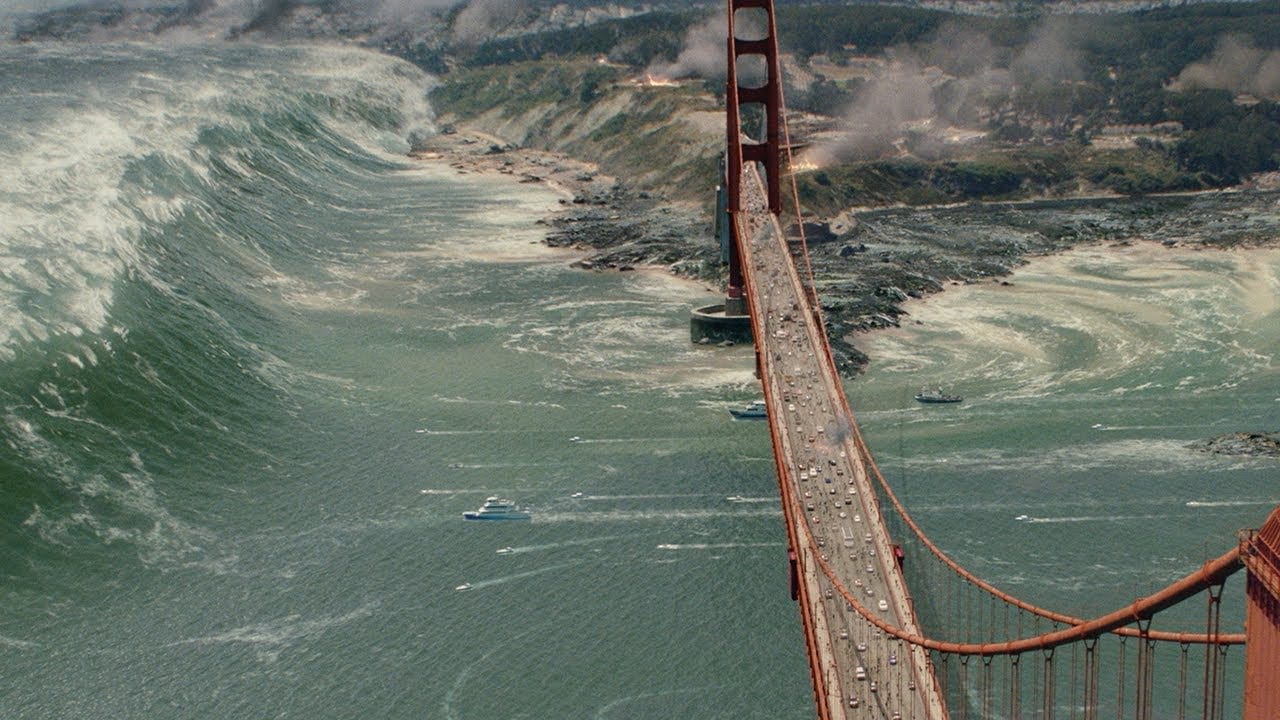
The movie San Andreas (starring Dwayne ‘the Rock’ Johnson) paints a picture of what would happen in California if it were hit with a Mega-thrust earthquake. On film, the Hoover dam is destroyed, skyscrapers topple, and an impossibly tall tsunami wipes out the city. This is great TV, but not good educational material.
If a mega-thrust earthquake were to hit the west coast of North America in the next 50 years (a one-in-three chance), it would cause a tsunami, however, it is likely that it would only be a baby one. The major fault lines along the west coast of the continent are too shallow to cause 40 meter waves like the Tōhoku earthquake off the coast of Japan in 2011. Scientists believe we are much more likely to experience waves from 5 – 10 meters in height, still dangerous and damaging, but hardly Hollywood material.
These waves will likely grow to 15 meters as they travel up inlets and channels causing plenty of damage and flooding before they peter out. Basically, unless you live within a few blocks of a beach or inlet, a tsunami isn’t going to be your biggest priority if we get a 9 on the Richter Scale.
What will happen is this:
- The ground will shake violently for several minutes.
- Your furniture will fall over, your paintings will fall down.
- If you live in an older or structurally unsound building it will likely collapse. Even if it stays standing you won’t know if it’s structurally safe. Newer homes may shift off their foundations.
- Fires will start and emergency response personnel will probably be overwhelmed, unable to stop all of the fires from spreading.
- Streets will become impassable with debris and sinkholes.
- You’re electricity will probably go out, likely for days or weeks.
- Gas and water pipes are extremely likely to rupture.
What does this mean for you? Well, it basically means you’re a little screwed, especially if you weren’t prepared. For those keeping track you just (hypothetically) lost: shelter, water, electricity, fast access to emergency services, the ability to travel quickly/conveniently, and -once your freezer warms up- your food. And Wi-Fi, we can’t forget the Wi-Fi.
Then there’s always the chance that one of the fires started in the earthquake reaches your home, but you can read about that here.
The good news is:
- Many buildings will still be standing.
- Many communities have disaster response plans that will help speed recovery time.
- If you haven’t prepared, your community’s rescue efforts will likely ensure that you don’t starve or die of thirst (though you won’t be comfortable by any means)
- You’re reading this article so hopefully you’re taking the steps to get prepared… just in case.
- Survival kits are useful in loads of situations. These could include anything- fires, floods, home invasions, rioting, burst pipelines, car breakdowns, volcanic eruptions, nuclear power plant meltdowns… You name it. So your investment is pretty solid.
Why do You Need Survival Kits?
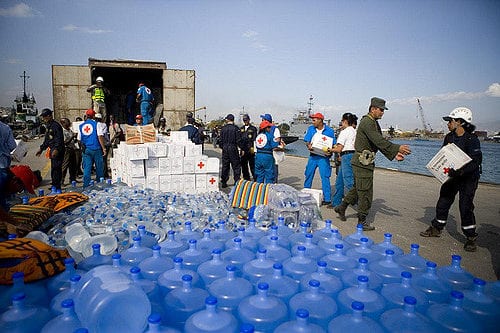
Honestly? Because you’re (probably) not Bear Grylls. It is unrealistic to believe the government will be able to bail you out immediately, or completely, if the worst should happen. Emergency Preparedness is a shared responsibility. If an emergency happens, and you are cut off from your basic facilities (electricity and clean water being the biggies) an emergency kit will help you to stay healthy and comfortable. Survival kits can make the difference between hungry refugee, and impromptu camper. Besides the basics of life, you can also add things to your emergency kit to make your family’s return to normalcy that much smoother.
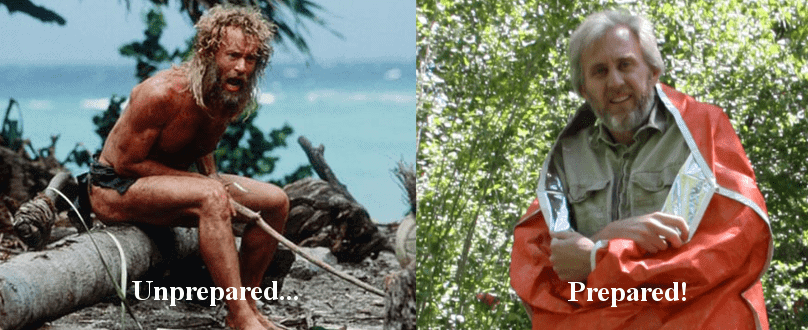
Tom Hanks from was unprepared for disaster in the film Castaway, while Preppy Peter is snug in his HeatStore Reflective Blanket.
A good survival kit will cover all of your basics. It should have a high calorie food source, clean water and/or a way to purify fresh water, tools to keep you warm (blankets and tents are favourites), and utility tools to help you build fires, see in the dark, deliver first aid, and the like. A great survival kit also includes some of the comforts of home. These may include a variety of meals (not just food bars), stove options for cooking, solar/crank cell phone chargers and hygiene kits- just to name a few.
Whether you buy or build a survival kit, make sure that you include copies of important documents, medications, and contact numbers. These will allow you to rebuild your lives more quickly and with less frustration than you could without. In the case of medications, it could also save the lives of your loved ones.
Buy or Build?
Hopefully I have managed to convince you that you will be better off with an emergency survival kit, but what now? Do you build your own, or buy a professionally compiled kit from a trusted Canadian distributor? Both are good options, and both have their advantages and disadvantages.
Buying a Kit
Pros |
Cons |
|
|
|
|
|
|
|
|
|
|
|
|
|
|
|
Building Your Own Kit
Pros |
Cons |
|
|
|
|
|
|
|
|
Naturally you can also combine both methods, buying a basic kit and supplementing it with your own items, or cherry picking your favourite professional items and filling your home-made kit.
What to look for? What are the differences?
Emergency kits come in all shapes and sizes. 72 Hour survival kits are the most common, and are a good option for smaller emergencies that will leave most of your local infrastructure intact. The BC government recommends that households be prepared to sustain themselves for at least week in an emergency. A mega-thrust earthquake could knock out infrastructure in rural areas for longer than that, so if you live in a remote place you will want to consider preparing for more time. All of these kits can often be mixed, matched, and adjusted to fit your specific needs.
72 Hour Kits
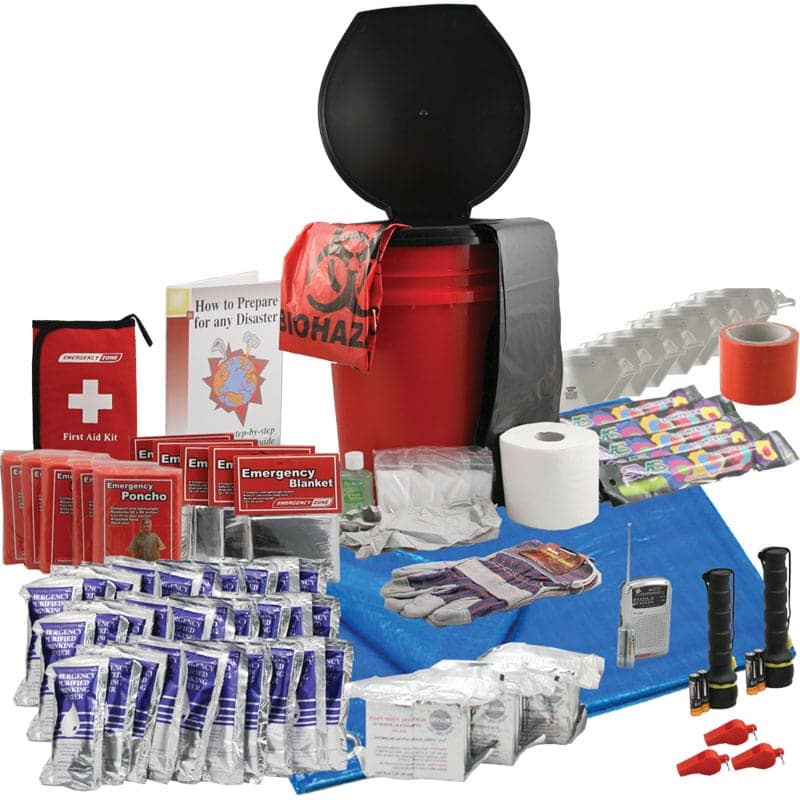
Most 72 hour kits come in 1 – 4 person sizes. At minimum these should include food bars (SOS bars taste like shortbread!), a preparedness guide, reflective blankets, waterproof protection (e.g. ponchos), survival tools, a first aid kit, and hopefully a hygiene kit. All of the kits listed below also include N95 dust masks to protect you from the dust kicked up in the event of an earthquake, one of the most harmful and least prepared-for dangers.
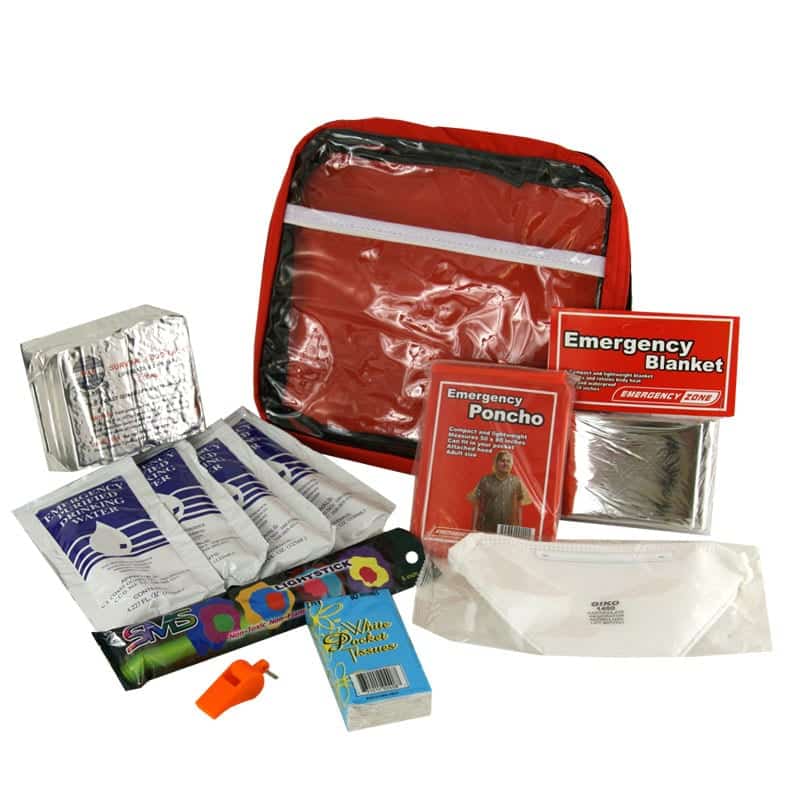
Individual Essentials Kits
Individual Essentials kits are the most affordable 72 hour kit option offered by Total Prepare. Starting at $29.95* these survival kits are designed to be a starting place for people who just want the basics. They make a great base to build from if you are looking to add your own items to a kit. If you are interested in this kit you may want to supplement it with some extra water pouches, a LifeStraw, or some Aquatabs, as the provided water supply is purely for base survival only.
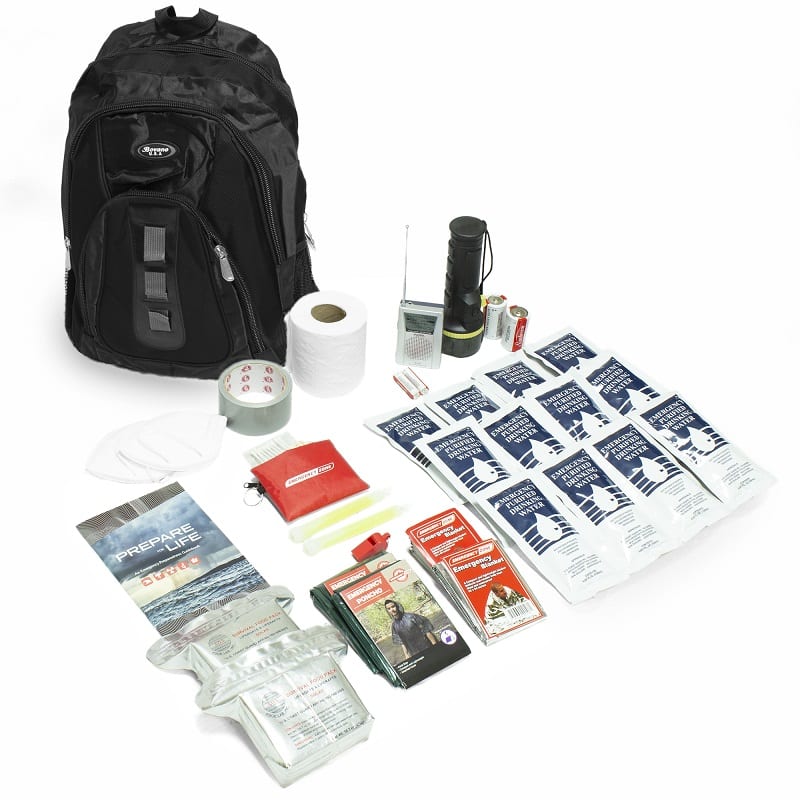
Backpack Essential Survival Kits
Essential Survival Kits are the next step up in price and supplies from the Individual Essentials Kits. This is our mid-range option, starting at $114.95*, for those looking for a little more than the barest minimum. This kit has a similar base to the previous kit with a few useful additions. These include water purification tablets (in addition to the water pouches), a flashlight, an AM/FM radio (with batteries), tube tents, and a larger variety of survival tools. This kit does not come with hygiene supplies.
Urban Survival Kits
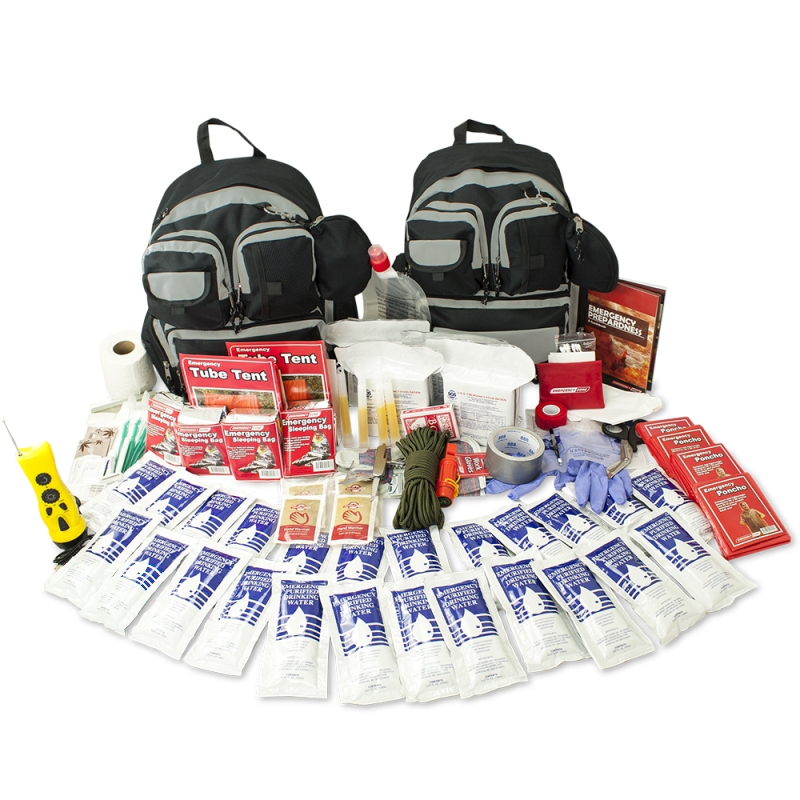
The Urban Survival Kits are our most popular 72 hour option starting at $199.95*. They start with all the same items as the Essential Kits with the following changes: Instead of a flashlight and a radio the urban kits include a solar/crank radio/flashlight all in one device that can also accept alkaline batteries. The Urban kit also upgrades the Essential’s first aid kit to be more extensive. On top of that, these kits contain: our best hygiene kit, additional survival supplies (including a sewing kit and can opener), playing cards, light sticks, and even hand warmers.
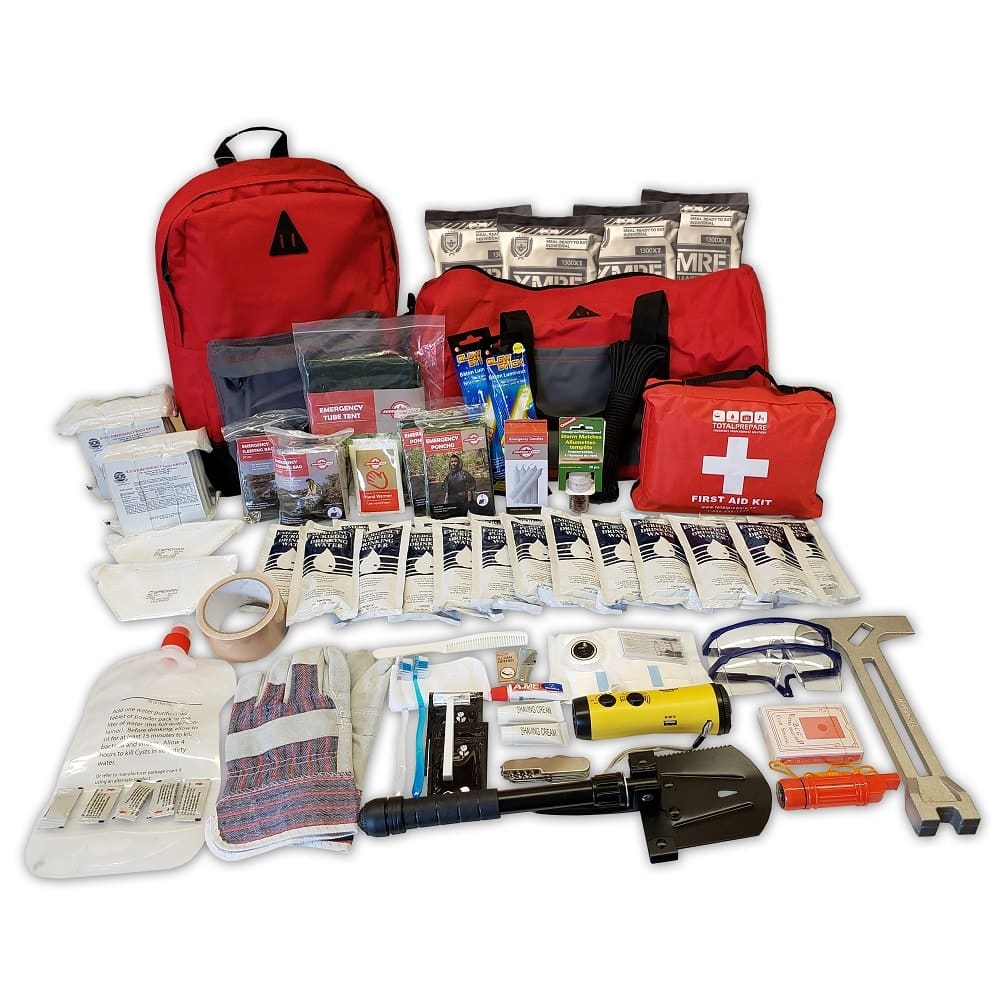
Premium 3 Day Earthquake Kit
The 2 or 4 person Premium Earthquake Kit was designed in-house by our team. Our intent was to build the ideal surivial kit that we would want to have in an emergency. It includes the highest daily calories of any of our 72 hour kits, self-heating meals, a large first aid kit, search and rescue tools (folding shovel, work gloves, safety glasses), and a 4 in 1 tool for turning off your gas and water valves. This kit is the best of the best for 3 days and starts at $384.95*.
*Prices subject to change.
One Week Kit
In the event of a major earthquake the minimum recommended amount of time to prepare for is one week. Kits for longer than 72 hours generally need to provide a larger variety of food options and nutrients. This in turn means that it needs to provide more water for cooking and cleaning, and also a way to cook the more complex food.
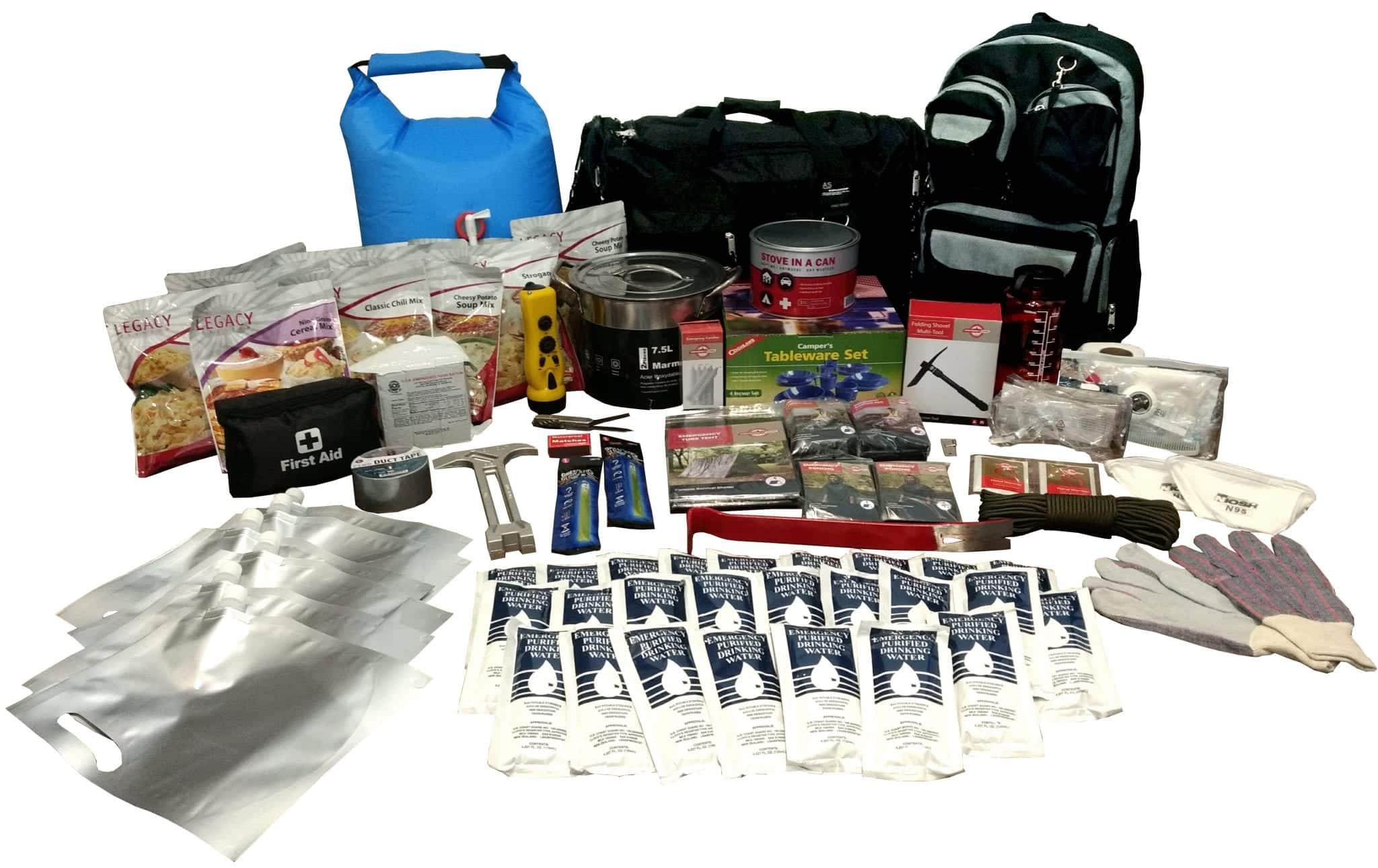
Starting at $474.95 these One Week Duffel Kits come in two and four person sizes. They set themselves apart from other kits by including a variety of baggage options (backpacks and duffels), and providing extra tools for digging latrines and searching through debris. It has an extensive array of survival tools and safety gear, and is also excellent for establishing a shelter-in-place for one week.
These survival kits feature premium freeze-dried food. With a 25 year shelf life these hearty, tasty meals will give you the extra nutrients and energy you need to get yourself and others safe and comfortable.
*Price subject to change.
Location Kits – How are they different?
Natural disasters are inconsiderate. Even the Canadian ones. They will strike any time with no regard to how it will affect YOU. If you work a 40 hour week then there is a 24% chance that you’ll be at work when a natural disaster occurs. In the event of a major emergency getting home from work, school, or wherever you’ve been stranded on the highway, could be difficult or even impossible. Depending on how well your local infrastructure survives you could be stranded for up to a few days. What’s more, if you work at a prominent business or government building you can expect your workplace to be a meeting place for local families looking for community support.
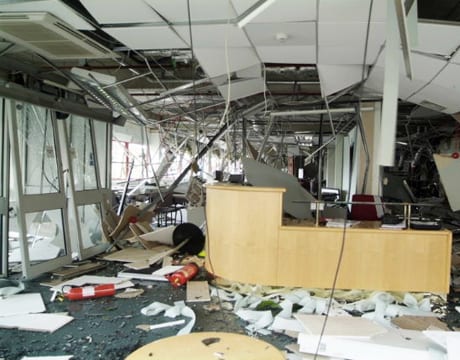
Office Kits
Unless you’re lucky enough to work in a preparedness store, it is unlikely that your office has enough emergency supplies. Providing enough supplies for your team, or company, or even just supplies for yourself, could save you a big headache in the future. There’s also a lot to be said for creating an EOC (Emergency Operations Centre) if you are buying for a larger company. Each of the below workplace kits are designed to last one day, with the assumption that the employees will want to go and rendezvous with family. If you desire more time, additional food and water options can be found here.
Under-desk Kit
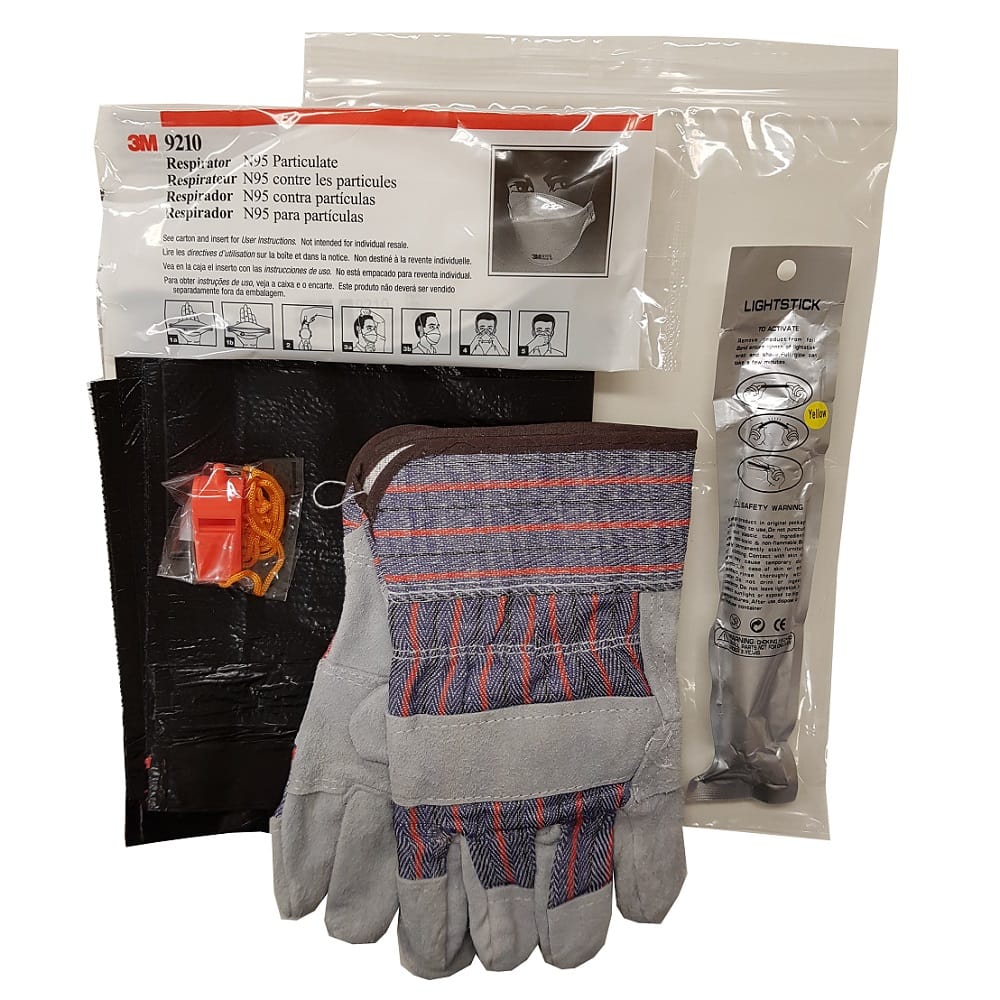
An Underdesk Kit is the bear minimum to have in your office. They can be secured beneath each employees desk with packing/duct tape and hold supplies that will be crucial for search and rescue or safe evacuation in the event of an emergency. If you are in an earthquake zone, and especially if your office has a lot of windows, this is a must have.
10 to 100 Person Workplace Kits
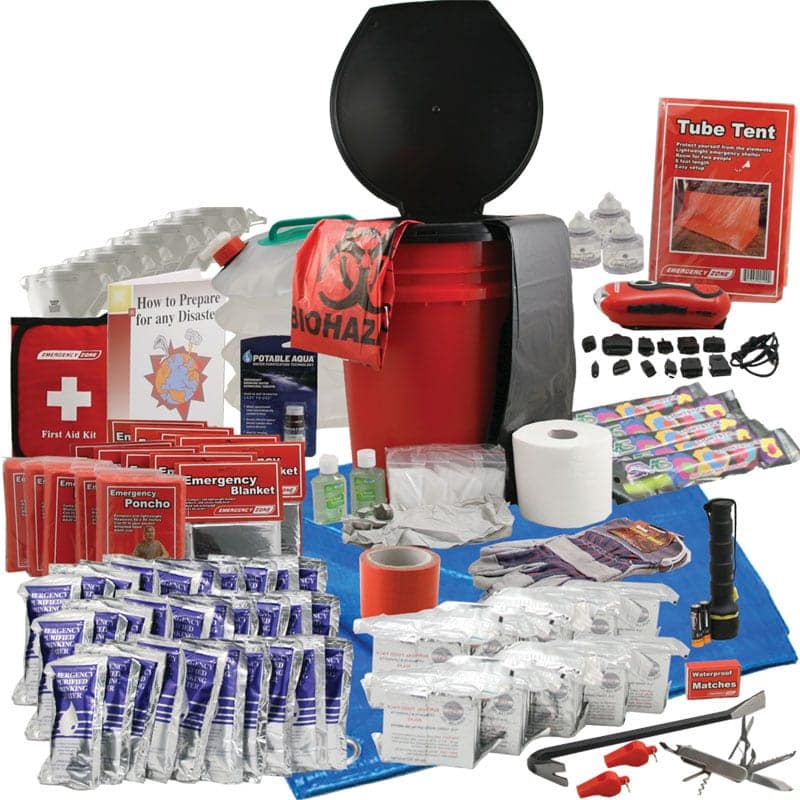
If you are providing for a large business, or if you think your building will be a meeting place in your community, you will likely need a larger survival kit. Total Prepare offers individual kits (above) that can be supplemented for more people, however if you are providing for 8 or more employees we highly recommend a larger kit.
These workplace kits include toilet kits, a feature that is often overlooked. The toilet kits allow for a safe, hygienic, and more comfortable way to deal with waste when indoor plumbing is no longer an option. These kits also include food and water for 1 day, dynamo flashlights and radios, a variety of utility tools and gear, blankets, tents, ponchos, and a first aid kit. Just what you need to keep any number of employees as comfortable as possible in an emergency situation.
Earthquake Cabinets
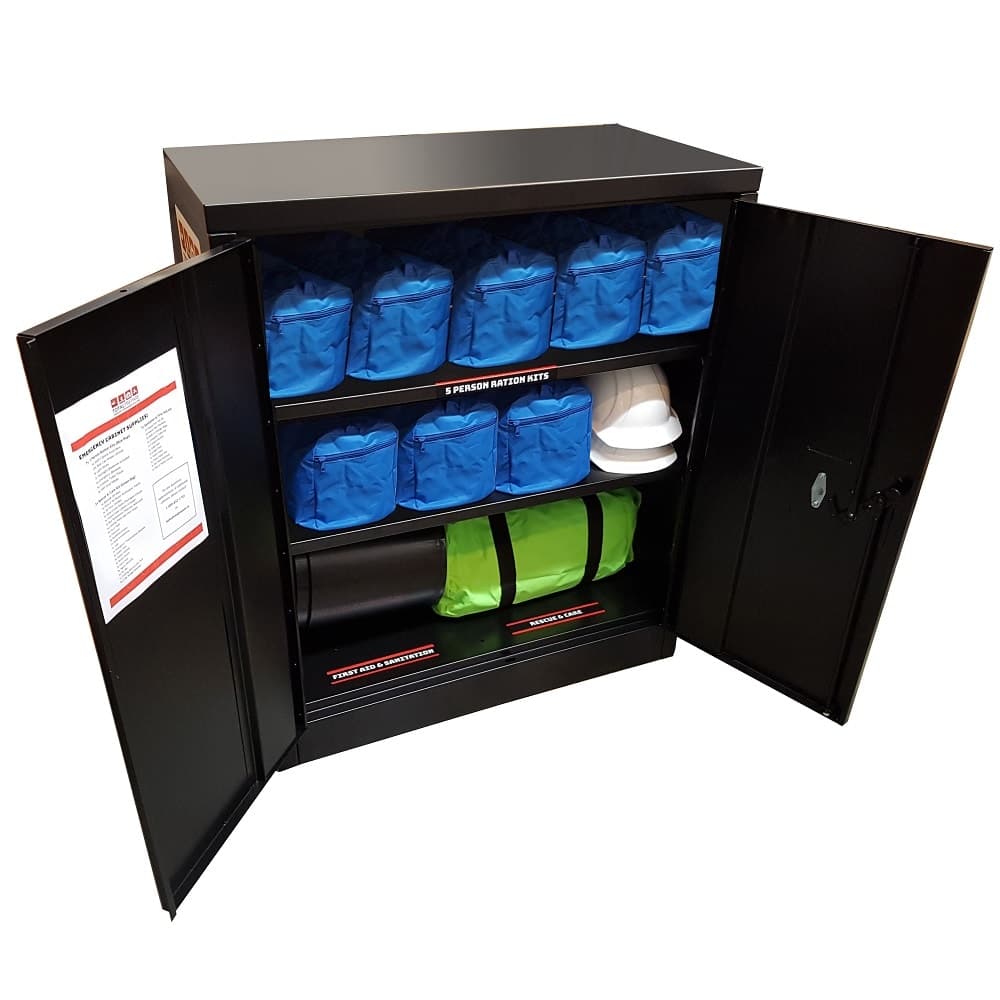
If you have the space, an earthquake cabinet is the single best way to prepare your team for an emergency. Total Prepare’s cabinets come standard with all the supplies you need to keep your team ready for anything. Contents include 50 year shelf life Blue Can Water, water treatment, search and rescue equipment, sanitation supplies, first aid, food bars, solar lanterns, flashlights, radio, and so much more! If you’re equipping a large organization please reach out to our team so we can ensure you get the best service available to you.
Car Kits
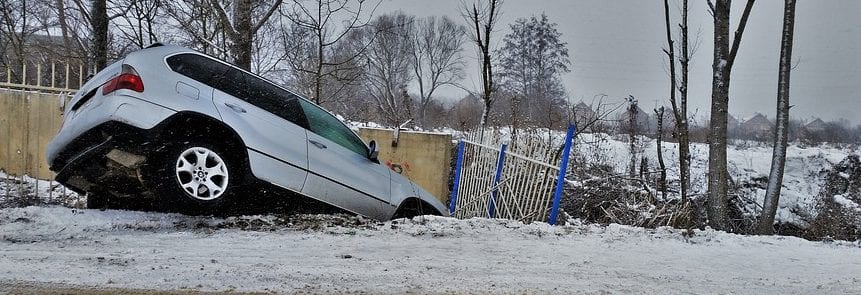
Your car is one of the safest places you can be in a disaster. It’s like your own personal tank and bunker all in one. It is also the #1 place where you are likely to need an emergency kit. Why? Because you regularly strap yourself inside a piece of metal and use controlled explosions to throw yourself over cement at unnatural speeds. It’s a recipe for disaster.
Vehicle survival kits are great for every day emergencies, you don’t need a mega-thrust earthquake to use one. A few extra resources make a big difference when accidents, flat tires, break downs, running out of gas, or getting stuck in snow or mud ruin your day.
The Survival Bottle
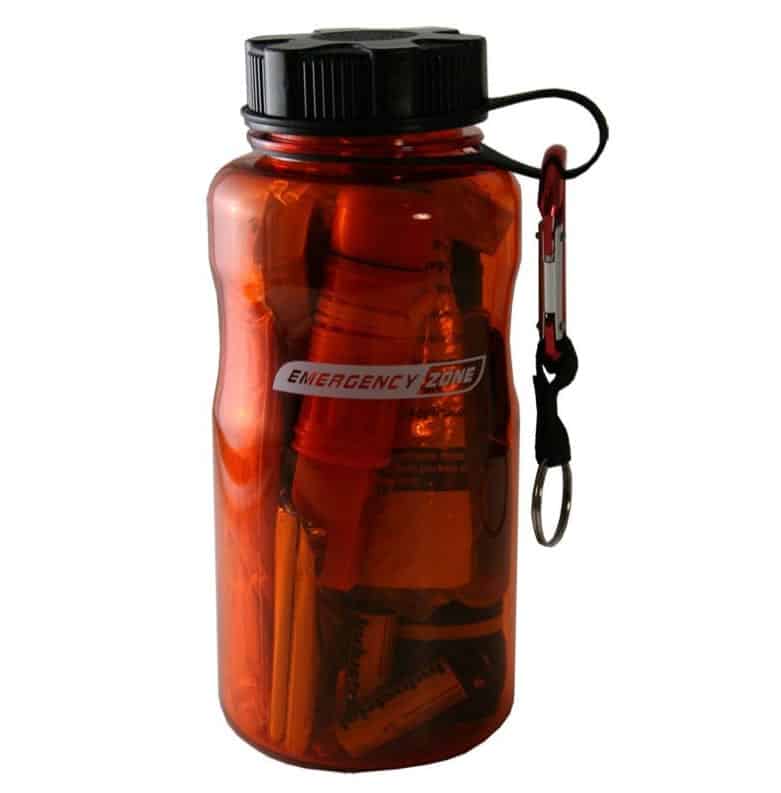
A great compact kit for the car, and an excellent gift, the survival bottle provides great bang for your buck. Priced at $32.95* this kit provides handy tools in case you find yourself stranded. It includes a blanket, poncho, multi-tool, glow stick, 5-in-1 survival whistle, flashlight (batteries included), a first aid kit, and a hardy water bottle with carabiner.
Premium Vehicle Safety Kit
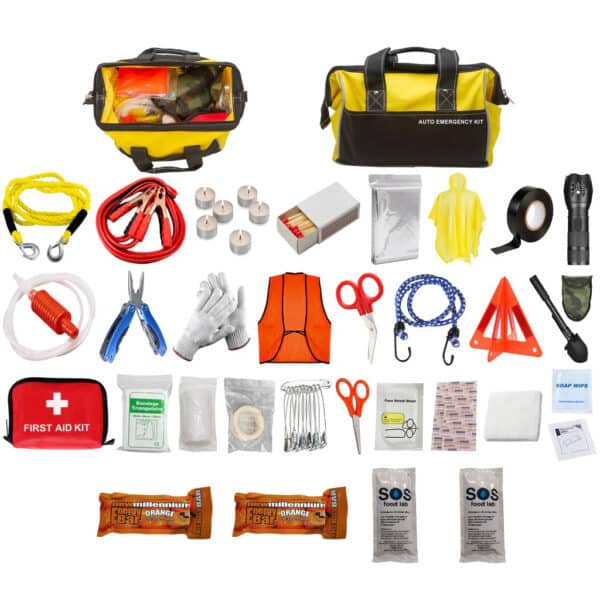
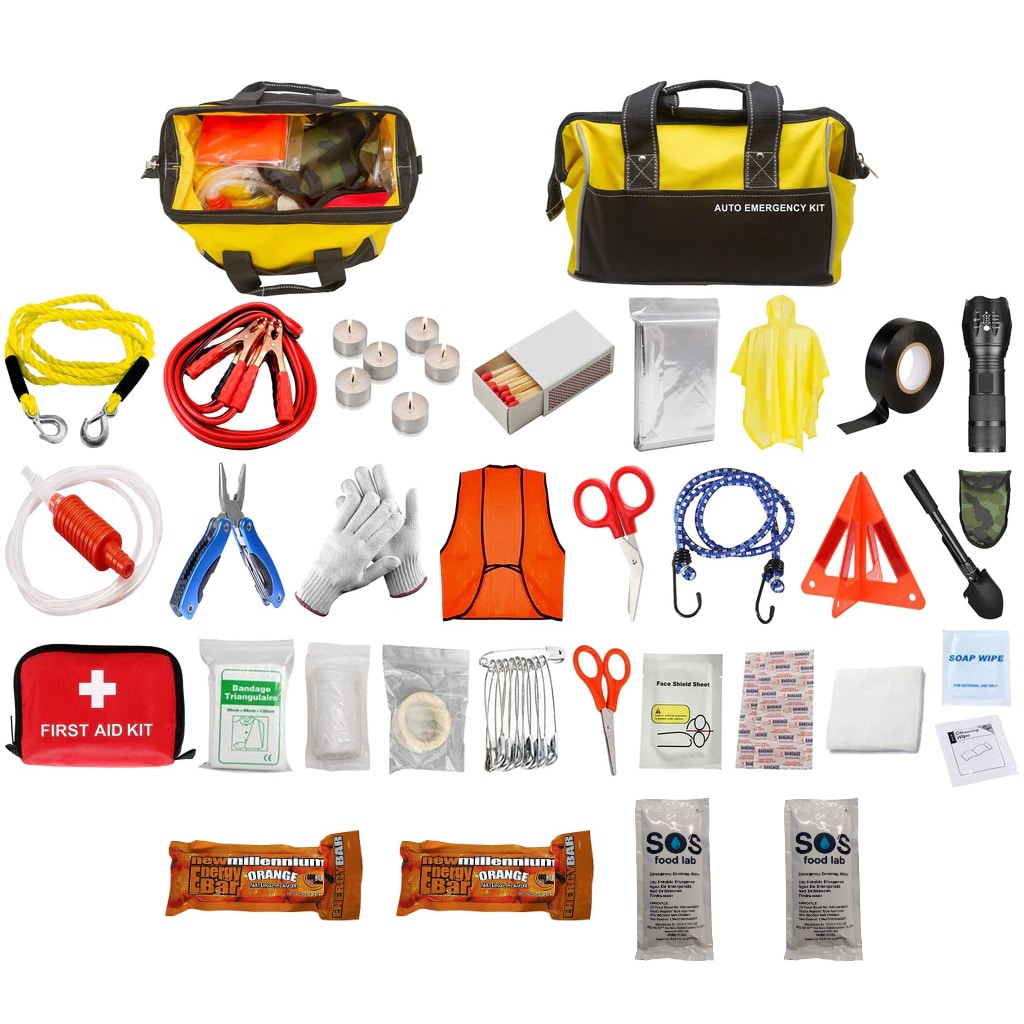
Do you worry about breaking down? The PremiumVehicle Safety Kit is the kit for you. At $99.95* it includes tools for staying warm, food and water in case it takes a while for help to arrive. This kit really stands out in breakdown situations providing car essential items such as jumper cables and a tow rope, but includes other vital items such as a reflective emergency triangle, work light, and ice scraper. This kit also includes a small first aid kit and even a syphon.
*Prices subject to change.
School Kits
As a general rule of thumb, kids can’t drive. In emergencies children are effectively marooned until a guardian can get to them. Be it school, daycare, or a place of worship- the institutions that care for children should always have at least one day of emergency supplies in place.
I would like to take a moment to offer our thanks for the teachers and staff in charge during an emergency. With families of your own at home we understand that it takes super-human compassion to stay and care for other people’s children. Thank you so much for what you do, and we hope that you find wrangling thirty children during a disaster a little easier with these kits.
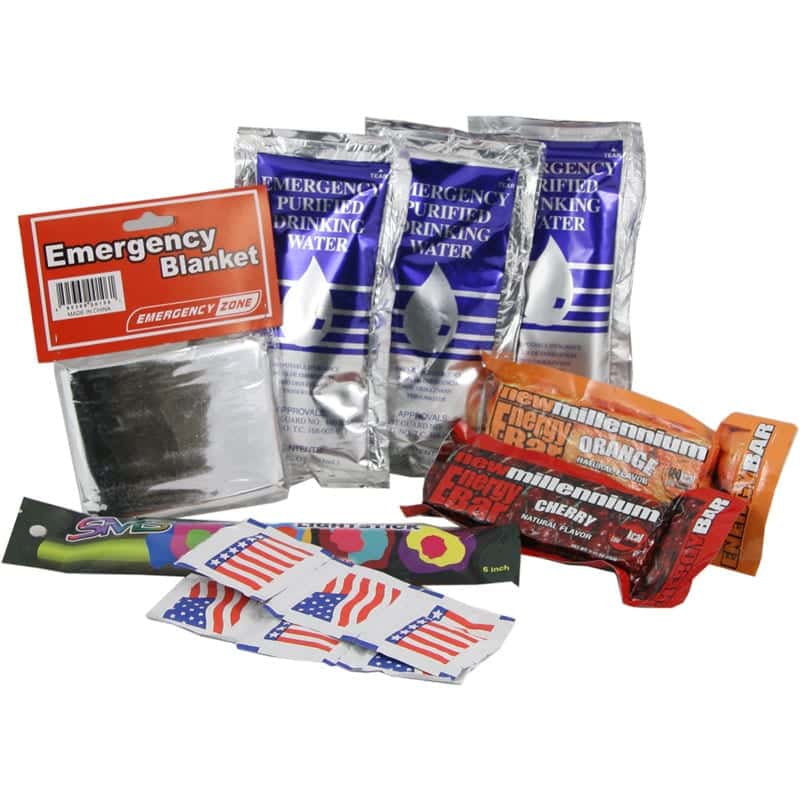
Basic Student Emergency Kit
This Basic Student Kit is designed to keep a student fed and watered for one day. It includes a foil blanket, lightstick, wet-wipes, water pouches, and Millennium Bars. Millennium bars are fruit-flavoured and more palatable to kids than SOS bars.
School Emergency Kits
Classroom kits provide a class of 30 students with enough supplies to survive for one full day. Total Prepare offers three different levels of preparedness kits for schools: Economy, Basic, and Deluxe.
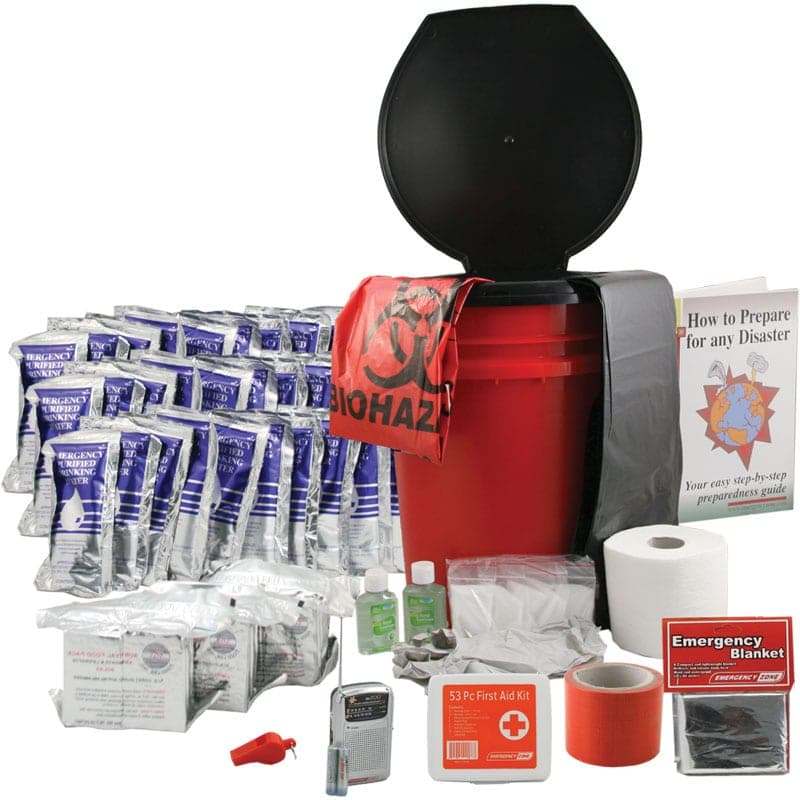
The Economy Classroom Emergency kit (shown left) covers food and water needs, and comes with a toilet kit. It includes a small first aid kit as well as a radio (batteries included), whistle, a reflective blanket, signal whistle, and duct tape.
The Basic Classroom Emergency kit (shown middle) includes all the supplies from the Economy kit but adds 4 more blankets and ponchos, a larger first aid kit, ten N95 dust masks, flashlights, extra whistles, plastic sheeting, and a tarp.
Finally, the Deluxe Classroom Emergency Kit (shown right) is ideal for school emergencies. This is based on the Basic kit but with some improvements. For starters, the Deluxe Classroom kit includes extra food as well as tools for purifying water. This is further supplemented by a Dynamo flashlight/radio with cellphone charging capabilities and extra tools for escaping/searching crumbling buildings. It also includes twenty-five N95 Dust Masks and candles.
Building Your Own Kit
If you’re looking to build your own survival kit there are a lot of great resources available to help you. Find the BC government’s tips on kit creation HERE. If that list doesn’t suit you there are thousands of bloggers who cover emergency preparedness. Simply Google “building an emergency kit” or “DIY emergency kit” and you will find hundreds of articles.
There are 8 areas of preparedness to consider when creating a kit:
Water, Food, Light, Heat, Shelter, First Aid, Communication, and Sanitation
These vary in importance depending on where you live. For example, heat is a much higher priority in Arctic regions than in balmy Victoria. Universally water is your #1 concern. Below is a suggested list of things to consider adding to your DIY kit.
- A water supply or purification tools (see here for information on purifying water.)
- A ready to eat food supply (e.g. SOS or granola bars)
- Long-term food options with a variety of nutrients (canned/dried meals, Legacy Food)
- Flashlights/lanterns with batteries (or a solar powered option) *Note, keep batteries out of the devices while storing. They last longer!)
- Tools for fire/cooking (matches, stoves, flint and steel, etc)
- Blankets, sleeping bags, and tents.
- A first aid kit
- A way to charge cell phones. (Texting will likely be the most reliable for of communication during a disaster.)
- A solid plan and tools for dealing with human waste. Toilet sets or a shovel for digging latrines.
- Medications, spare eye glasses, extra keys to your house/car, baby/pet supplies.
- A few photos, work gloves, extra garbage bags, dishes/pots/utensils, cash, etc, to make yourself more comfortable.
- Copies of: Insurance documents, ID, contact lists, medical records.
- A USB stick with family pictures, resumes, your novel, and any other data that might be difficult to reproduce.
- A hardy, preferably water resistant bag to keep it all in.
Don’t over pack. You may find that you need to carry your kit to a community meeting spot, or to higher ground.
Summary
The odds of a mega-thrust earthquake striking today are approximately 7 in 1,000,000 (-ish, I am not a mathematician.) Those are long odds, but they get shorter every day. Add the chances of fire, flood, government break down, divine retribution, burst pipes, etcetera, and suddenly the risk skyrockets. Don’t take that gamble. With a small investment today you could arm yourself with the knowledge and equipment to be ready for anything. Whether you prefer to buy or build your survival kit, all we ask is that you take the steps to get prepared.
Thank you for reading.
Article written by Zenia Platten – Author of Tethered and emergency preparedness professional.